Computers
What's it About?
The first computer wasn't built in a garage in California's Silicon Valley, but in a living room in Berlin-Kreuzberg. In the exhibition, you'll hear fascinating stories about the development of the first computers and learn more about the life and work of computer pioneer Konrad Zuse.
The First Computer
The exhibition centers on the first computer, the Z1. In 1935, Konrad Zuse, a 25-year-old engineer from Berlin, began tinkering with a calculating machine designed to perform all tedious and complicated calculations independently and fully automatically. To make this vision a reality, he took over his parents’ living room with his computer project for several years, rounded up friends to help him build it, and quit his job. Konrad Zuse was a “nerd” long before the term even existed.
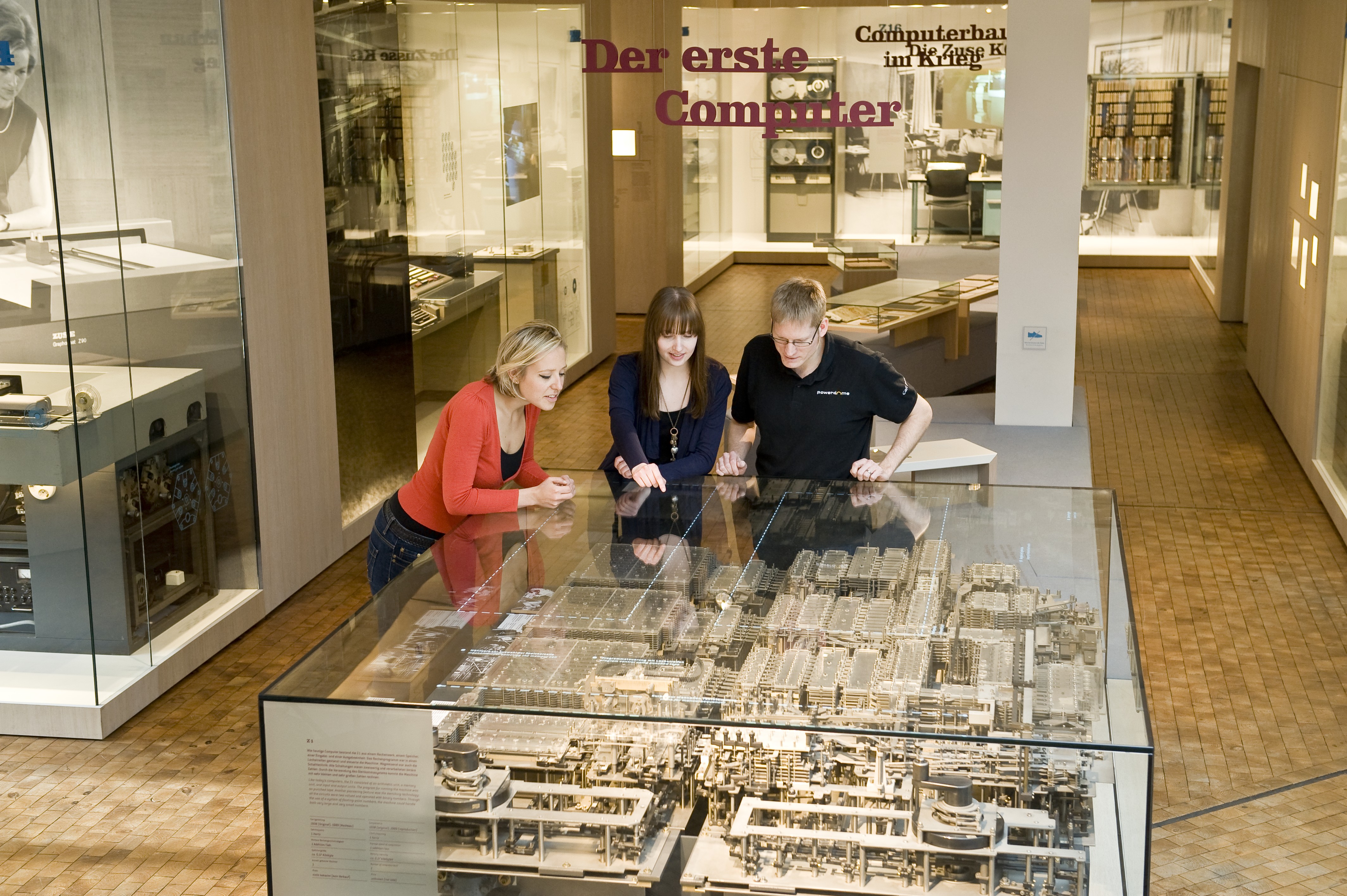
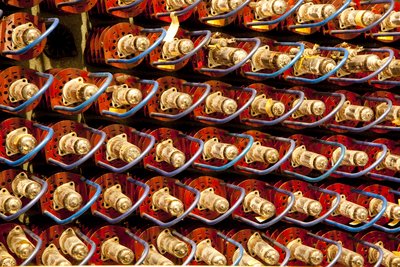
In 1938, Konrad Zuse had completed his Z1; the computer was freely programmable and controlled mechanical relays that moved metal pins into two different positions —“0” and “1.” This binary principle still forms the basis of every computer today. The Z1 was destroyed during World War II — which is why Konrad Zuse rebuilt his pioneering computer for the Deutsches Technikmuseum in 1989. Today, you can see this fascinating piece of technological history in the exhibition and trace the evolution from binary mechanical switching elements to today's use of computers.
Computer Engineering During the War
The inventor Konrad Zuse was anything but satisfied with his first computer model. Although the Z1 functioned in many ways like modern computers, its mechanical switching elements frequently jammed. Zuse therefore replaced them with electromagnetic relays and, in 1941, unveiled his first reliably functional model, the Z3. The Z3 was also destroyed during the bombing raids; the exhibition features a modern replica.
Zuse’s machines were not only victims of destruction; they also played an active role in the devastation of World War II. For the Berlin-based Henschel Aircraft Works, Zuse designed the S1 and S2 special computing machines, which were used to calculate the wing design of glide bombs. A fragment of the wreckage from one such glide bomb is on display in the exhibition and places Zuse’s work in the context of World War II and National Socialism.
Inventor and Entrepreneur
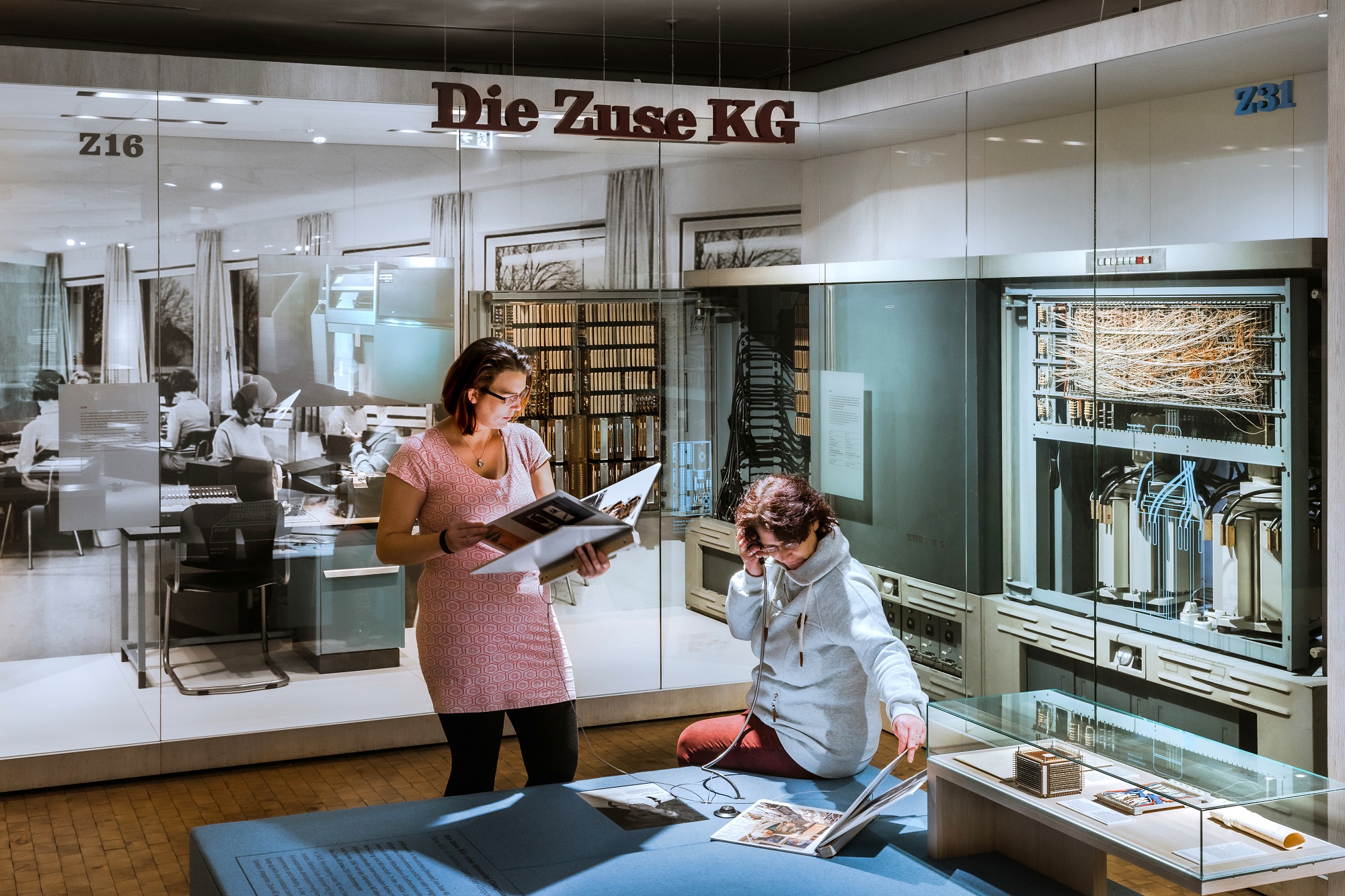
In 1941, Konrad Zuse founded the world’s first computer company, Zuse-Apparatebau Berlin. Zuse’s company was classified as “essential to the war effort” and benefited from numerous contracts from the Reich Aviation Ministry. After the war, the newly formed Zuse KG in Hesse developed large-scale computing systems for science, government, and business. Historical film footage shows the large-scale computers on display in action. The exhibition brings to life not only the history of Zuse KG, but also the technological and economic history of the Federal Republic of Germany.
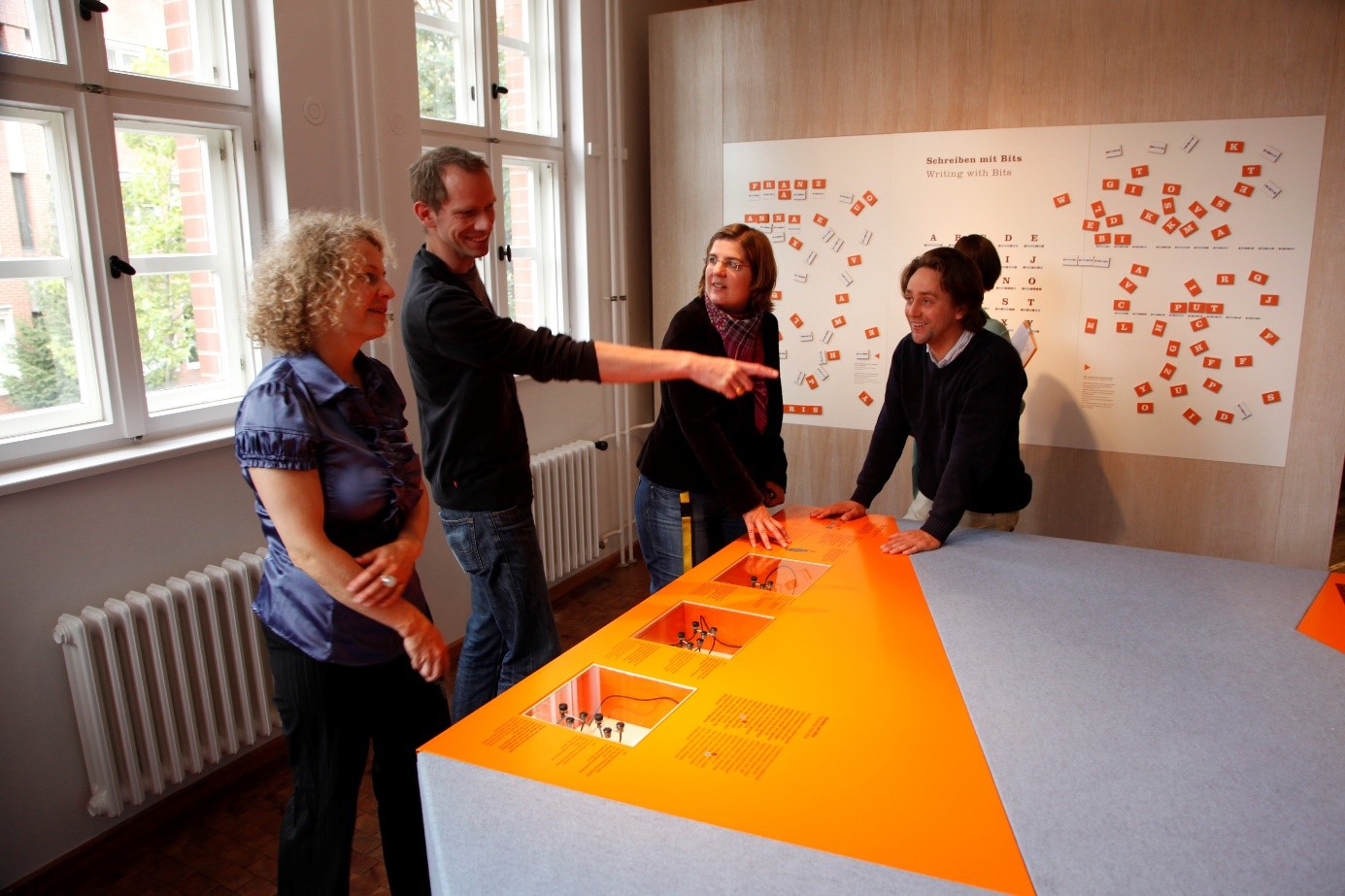
In the hands-on area, you can also experience the basic principles of computers in an interactive way. Would you like to know how your name is written in computer code, or how a computer can represent everything using only zeros and ones? Then come on by and find out here!
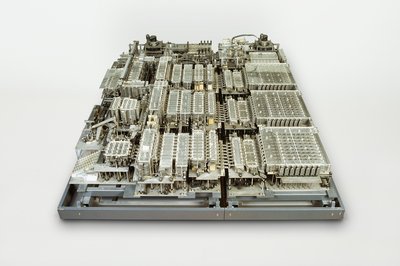
Z1
Konrad Zuse's first computer, the Z1, consists of about 30,000 individual parts. The Z1 is program-controlled and freely programmable, operates in the binary system using floating-point numbers, and features a program, processor, memory, monitor, and keyboard. Although it functions purely mechanically without electricity, it already possessed all the essential elements of modern computers. The original machine was destroyed during World War II — which is why Konrad Zuse rebuilt his pioneering computer for the Deutsches Technikmuseum in 1989.
Konrad Zuse, 1989, replica (original: 1938)
SDTB/ Photo: C. Kirchner
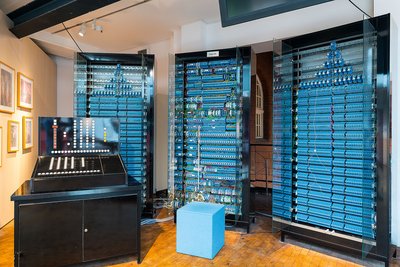
Z3
The Z3 is a further development of Zuse’s Z1 computer prototype. Instead of error-prone mechanical circuits, he used electromagnetic relays as switches in the Z3. Konrad Zuse presented the original to a group of scientists in May 1941. A replica built by his son, Horst Zuse, is on display at the Deutsches Technikmuseum.
Horst Zuse, 2010, replica (original: 1941), on loan from Horst Zuse
SDTB/ Photo: C. Kirchner
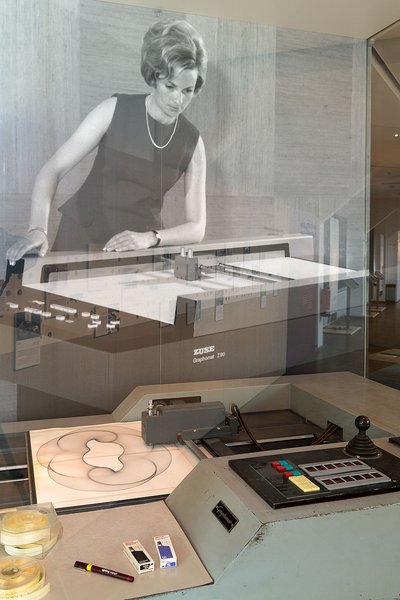
Graphomat Z64
The Z64 is an automatic drawing machine controlled by punch cards. It was sold by Zuse KG starting in 1961, making it one of the world’s first plotters. It is controlled by two planetary gearboxes that convert the digital signals on the punched tape into analog x and y movements. The device can draw dots, arbitrary curves, and symbols in four colors. The Z64 was used, for example, in surveying, meteorology, and by the pioneers of computer art.
Zuse KG, 1961, Donated by: Technical University of Berlin
SDTB/ Photo: C. Kirchner
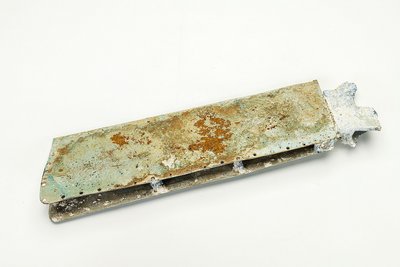
Wreckage of a Henschel Hs 293 Glide Bomb
The remote-controlled glide bomb was built by Henschel Flugzeug-Werke under strict secrecy during World War II. Konrad Zuse played a key role in the bomb’s development. To optimize the wing design, he built special computing devices. The German Wehrmacht used the new weapon primarily to destroy ships in the Mediterranean.
Henschel Flugzeug-Werke, 1942
SDTB/ Photo: C. Kirchner