
Microcosmos – Macrocosmos
How large is the universe, and how small are molecules? How fast is light? What is radioactive radiation? And: how can we visualize all these things?
Models of the Very Large and the Very Small
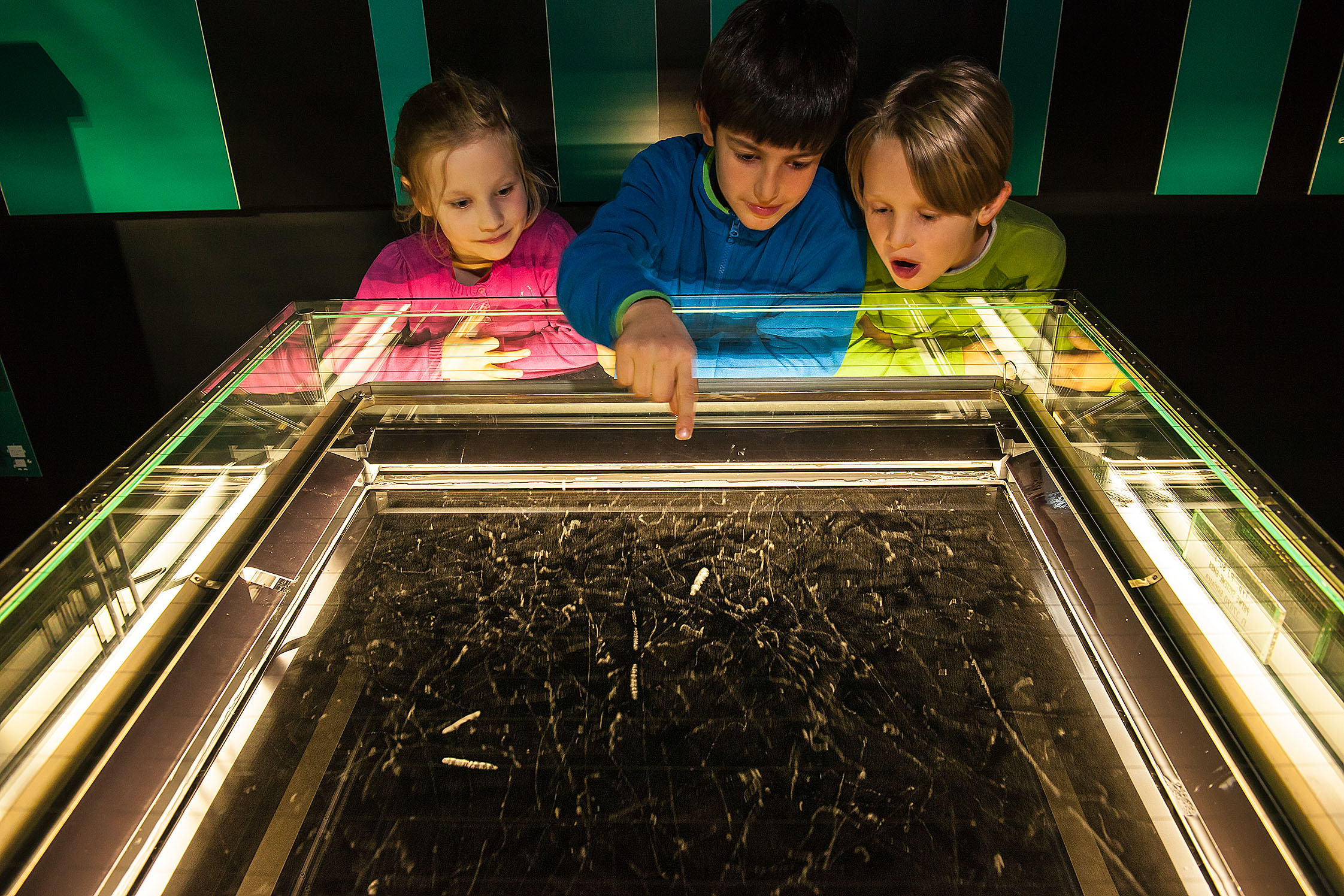
Guide the glowing filaments in our plasma tube and plasma ball. Observe the traces left by the smallest particles in a cloud chamber. Or check out how your reflection would look if the mirror were on the moon.
Too Big or Too Small for the Naked Eye
Earlier in human history, it was not possible to observe the world of very small things – the microcosm – or the world of very large things – the macrocosm. People could only apprehend a small portion of their environment: the portion they could perceive with their unaided senses.

Microcosmos
Devices like the microscope or the laser make it possible for people to expand their realm of experience and peer into the world of the tiniest things. This has given us insight into the makeup of human cells and matter.
Modern science shows that different laws apply in the microcosm than in the world we immediately perceive. Especially in physics, traditional views about atoms, particles, and light turned out not to be valid. They have since been replaced by new models – models that often exceed the bounds of the human imagination.
Simplified models can be helpful and useful – even though they do not reflect, or only partially reflect, “true reality.” Ultimately, however, no one alive today knows what “true reality” actually looks like.
Macrocosmos
In contrast to the microcosm, the macrocosm encompasses the world of extremely large things. Here, too, human beings rely on various tools and models.
In astronomy and cosmology, mathematical models help to make the composition, structure, origin, and development of the universe intelligible to us.